
Colorado Warrant Checks
A personal warrant check in Colorado starts with the paperwork you already have. Pull out the ticket, summons, release form, or letter and find the court, the county or city, the case number, and the next date. Colorado has no public statewide active-warrant search. A court calendar may show a hearing, but it is not a warrant register. CBI's criminal-history product will not confirm warrant status either; its public FAQ sends warrant questions to the issuing agency. Match the channel to the record. The Colorado state court's docket and document-request service can locate court material, while a county sheriff may offer a local warrant lookup or confirm by phone. A Colorado city case belongs with its municipal court. If nothing is online, ask the Clerk of Court or records custodian how to file an official request.
- Read your own citation or Colorado court notice and note the court, location, case number, and date. A Colorado city-ordinance ticket may name a municipal court rather than a state court.
- Check the Colorado Judicial Dockets calendar for a case or hearing. Treat a calendar entry as a lead, not proof that a warrant remains active.
- Open the official Colorado county sheriff channel for the place tied to the case. Some offices publish a search; others ask the person to call their warrant unit.
- For a municipal ticket, contact the Colorado city court named on it. A county search may not include that city's ordinance cases.
- When online sources do not settle the question, contact the Clerk of Court or use the Colorado Judicial Branch record-request form. A records request obtains Colorado court documents; it does not recall an order.
- Ask the court and serving agency to confirm current status, bond or appearance terms, and any approved way to resolve the matter. Use Browse Counties to find the local route.
Colorado Has No Public Statewide Warrant Search
Colorado posts no public statewide warrant search, and that gap shapes everything else about Colorado warrant records. CICJIS connects justice agencies, and Colorado's CCIC works with NCIC for restricted law-enforcement use. None of those systems is a public name-search tool. No Colorado government source offers a public index with a county selector, complete warrant fields, or a promise that every court reports to one searchable page. The public tools answer narrower questions. The Colorado Judicial docket calendar lists hearings, CBI's criminal-history check is separate, and the Most Wanted Sex Offenders PDF is a curated fugitive program. Not one of them is a full list of active warrants. Remember that an empty result does not clear a Colorado warrant; confirm with the issuing court and the agency serving it.
Colorado's Statewide Warrant System
Colorado does not run a public statewide warrant-search portal. Its statewide infrastructure exists for justice information exchange. The Colorado Integrated Criminal Justice Information System (CICJIS) links participating justice agencies, while the Colorado Bureau of Investigation (CBI), within Colorado's Department of Public Safety, administers the Colorado Crime Information Center and supports national and interstate interfaces. For public purposes, Colorado court and sheriff routes still depend on the originating case. A restricted record can help authorized officers share information. It cannot replace the court's order, set bond, or recall a warrant. Colorado's systems offer no universal public lookup, and they do not prove uniform municipal and county coverage. The Colorado warrant database overview explains those roles in detail.
Five CICJIS Partners Share Case Data
CICJIS in Colorado is an interagency exchange, not a central court or public warrant list. Colorado Judicial identifies five partners or branches whose roles let information move between court and law-enforcement systems. The local courts and agencies still hold the records that confirm and resolve a particular warrant.
| Partner | Role named in CICJIS material | Public warrant lookup? |
|---|---|---|
| Colorado Judicial Branch | Court-side information and case-management connection | No complete public warrant index |
| Colorado Department of Public Safety / CBI | State criminal-justice systems and CBI interfaces | No; CBI directs status questions to the issuing agency |
| Colorado Department of Corrections | Participating justice information partner | No |
| Colorado District Attorneys' Council | Participating prosecution partner | No |
| Colorado youth corrections | Participating youth-justice partner | No; youth records have separate access limits |
Colorado publishes no county-by-county feed map. Nothing says every municipal warrant appears in each system. Treat a CICJIS connection as a data link, never as a complete public warrant search.
How Colorado Warrant Data Moves
A Colorado warrant begins with a court case. The court keeps the order; a sheriff, municipal police agency, or other authorized officer may serve it. Information can move through justice systems used by courts and law enforcement: issuing court and case record → service agency → restricted Colorado and federal systems → service update returned to court.
The Colorado Judicial CICJIS overview describes the interagency links behind that data flow, covering the system explanation and partner context rather than any public warrant lookup.
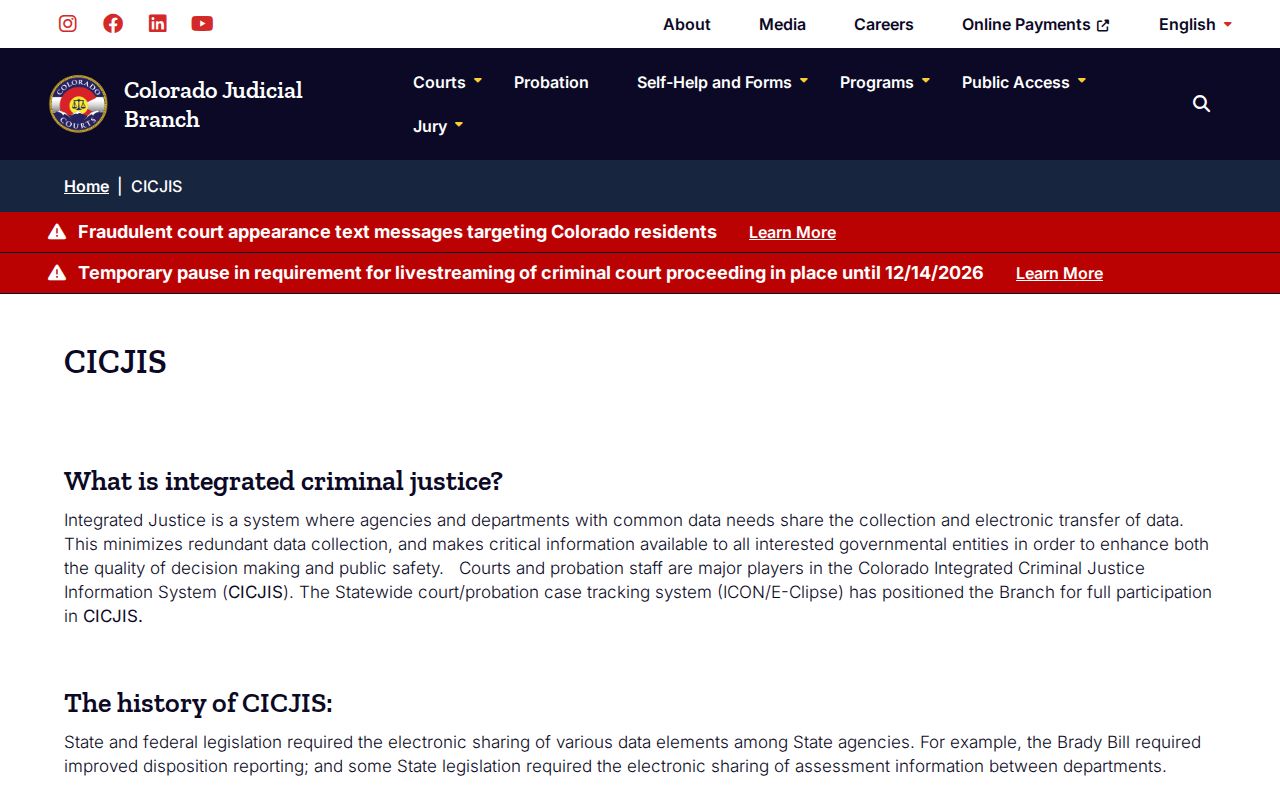
The Colorado Judicial page explains system roles, not a person's warrant status or full local coverage. Colorado Judicial describes how courts and law enforcement exchange data. A 2013 National Center for State Courts profile traces the historical link from court case management through CICJIS to CBI's CCIC warrant system. That technical history is not a current public directory. It shows no universal update time, completeness measure, or roster of county and city feeds. If a Colorado case names you, start with the Clerk of Court. Ask whether the order is current, then ask the assigned sheriff or city agency about service. A Colorado record request can supply a document. Only the issuing court can change its order.
Warrants in Colorado: The Main Types
Colorado warrant records reflect different court actions. An arrest warrant authorizes custody under a probable-cause process. A bench warrant is issued within a case, often after a missed date or another court-directed event. A search warrant authorizes a search for evidence, not an arrest. Colorado city courts can issue process for local ordinance cases, and each carries its own record and service path. One naming point matters here. Colorado does not use "capias pro fine" as the general statewide name for a fine-collection warrant. Outstanding Judgment/Warrant (OJW) is a narrower traffic and driver-record label. The table separates these terms so you can identify the process described on a notice and ask the issuing court the right question.
| Warrant Type | How It Arises | Who Issues It |
|---|---|---|
| Colorado arrest warrant | Probable-cause process in a criminal case | Authorized judge or magistrate |
| Colorado bench warrant | Missed appearance or another court-directed basis, when permitted | Judge or authorized court officer |
| Colorado municipal warrant | Local ordinance or city traffic case | Municipal court |
| Search warrant | Judicial authorization to search for described evidence | Judge or magistrate |
| Federal warrant | Federal criminal or court process | U.S. District Court |
| OJW | Specific traffic-related statutory judgment/warrant context | Issuing traffic court under applicable law |
Colorado law treats state traffic infractions differently from traffic misdemeanors and municipal offenses. A missed Colorado state traffic-infraction hearing alone cannot support a bench warrant under the cited statute. That rule neither erases the Colorado ticket nor applies automatically to other court matters.
Colorado Traffic OJW Is a Narrow Label
Colorado's OJW label covers less ground than people assume. It is not a stand-in for every Colorado warrant. You will find the term in Colorado traffic statutes and in the Judicial Branch fee schedule. The $30 attached to it is a court fee, nothing more. It is not a bond figure or a flat price to clear any warrant. Ask the traffic court whether it applies and what balance is left, because the Colorado traffic-warrant process differs for an infraction, a misdemeanor, or an ordinance case. Colorado also runs no OmniBase-style statewide program and no public lookup for failure-to-appear or license-renewal holds. Since January 1, 2022, HB21-1314 blocks the specified OJW from being used to deny a license issuance, renewal, or reinstatement. That law does not erase the court case, wipe every debt, or cancel unrelated warrants and separate license actions, so contact the court about the case and the DMV about your driver record.
Colorado Warrant Records: What They Show
Colorado posts no uniform public layout for warrant records. A county sheriff search, a municipal portal, a state-court docket, and a restricted law-enforcement entry can each show different details. The court file may name the case and the issuing court, while a local page offers only a name search or service instructions. So treat any result carefully. Not every Colorado hit will show a bond, a status date, a judge, a charge, or the serving agency. Use those fields as a checklist, not as a promise about what a portal must contain. A blank result can mean the record sits outside the tool's scope, is restricted, is too new, is held by another agency, or is simply not online.
| Warrant number | No shared format was confirmed in public Colorado sources; use the identifier shown by the issuing court. |
|---|---|
| Case and court | Case number, case class, year, county or location, and filing court help identify the correct record. |
| Person identifiers | A name and, where the official tool asks, date of birth can help distinguish similar names. Do not rely on a name alone. |
| Order and event | The order date, issuing judicial officer, reason, later docket activity, or service return may appear in the court file. |
| Charge and bond | Charge, bond type, amount, or release terms vary by case and may require direct court or jail confirmation. |
| Status | Terms such as active, served, recalled, or quashed are not a verified uniform statewide public code set. |
Unclear identifier or status? Pull up the Colorado docket with the warrant order and call the Clerk of Court. The sheriff can walk you through the service record. The issuing court still controls the order.
Colorado Warrant Terms in Plain Language
Colorado court papers lean on legal terms that sound alike but mark different events. These definitions come from statewide sources. On any Colorado case document, the court and the applicable rule fix the meaning.
- Failure to appear (FTA)
- Missing a required court date. Consequences depend on whether the case is an infraction, misdemeanor, felony, or municipal matter.
- Outstanding Judgment/Warrant (OJW)
- A specific traffic-related statutory label. It does not name every warrant in Colorado.
- Recall
- A court action withdrawing its warrant, often after a motion, appearance, or other case step.
- Quash
- A court order setting a warrant aside. The motion and process vary by case and court.
- Bond forfeiture
- Court action involving bond after a required appearance is missed, subject to the order and governing law.
- CCJRA
- The Colorado Criminal Justice Records Act, which governs access decisions for criminal-justice records held by covered custodians.
Colorado uses no general "capias pro fine" label. If an older Colorado court paper or local document says "capias," ask the issuing court which order that word covers. Do not treat it as a statewide code.
Warrant Record Access Under Colorado Law
Access to records in Colorado turns on three things: the record itself, who keeps it, and whether a law or court order restricts it. The Colorado Open Records Act (CORA) covers many state and local government records. The Colorado Criminal Justice Records Act (CCJRA) governs criminal-justice records held by covered custodians. Court records answer to Chief Justice Directive 05-01 and related judicial rules. None of this adds up to a searchable statewide warrant list. The official Colorado Judicial access guide points you to the filing court and explains the limits on direct online access. A records custodian makes the final call on what gets disclosed or redacted. That keeps the real answer local, court by court, rather than one click away.
Colorado access rules to know:
CORA, C.R.S. §§24-72-201–206 covers general state and local public records, with statutory exceptions.
CCJRA, C.R.S. §§24-72-301–309 gives records custodians authority to assess criminal-justice record access.
Chief Justice Directive 05-01 sets court-record access categories and restrictions.
C.R.S. §19-1-304 limits access to many juvenile records.
Sealed, juvenile, confidential, or active-investigation material in Colorado may stay closed to the public. A records request will not recall a warrant. For current status and next steps, contact the issuing court and the service agency.
Colorado Warrant-Clearance Days Are Local
Colorado runs no standing amnesty week and no statewide warrant-clearance counter. Individual Colorado Judicial districts sometimes announce events for eligible cases. Each one sets its own date, courthouse, case types, and exclusions. A past notice is no guarantee the program is still open or that every warrant qualifies. The Colorado Judicial press-release archive has listed Denver-metro clearance days and a Summit County Combined Courts event held September 19, 2026, which had passed by September 24, 2026. Before you show up at a future session, confirm eligibility, the required date, any fees, and the conditions with the court named in the current notice. Remember that an event can address a warrant without disposing of the underlying case.
One Colorado Task Force Reported 566 Felony Warrants
A February 4, 2026 U.S. Marshals Service release credits the Colorado Violent Offender Task Force with clearing 566 active felony warrants and making 498 fugitive arrests during 2025. Impressive numbers, but narrow ones. They describe a single federal-led program, not all active warrants in Colorado. Arrests and warrants are separate measures, too. Colorado publishes no public total for CCIC warrants or for all outstanding court orders, so the task-force results are not a statewide clearance rate. If you are checking a Colorado case, the issuing court and the responsible sheriff or police agency remain your real sources.
Colorado's Justice Data Exchange Dates to 1998
Colorado's public account of CICJIS traces the project to HB95-1101 and SB96-221. Design work began in July 1996. Basic statewide infrastructure went live on May 4, 1998. Those milestones mark a justice-information exchange, not the launch of a public warrant search. Colorado Judicial describes warrant data flowing to CBI and service notifications flowing back to Judicial. A 2013 National Center for State Courts profile offers an older technical view of the Colorado Electronic Warrants System and its court-to-CCIC connections. Treat that history lightly. It does not prove today's public coverage or timing, so people still confirm cases with their court and service agency.
What to Do About a Colorado Warrant
Colorado has no single statewide counter that clears warrants. Your first job is learning which Colorado court issued the order and whether the warrant is still active. The clerk of that court can tell you. From there, the path depends on the case: a scheduled appearance, a walk-in, a motion to recall or quash, a bond, or payment of the underlying fine. Only the issuing Colorado court decides which options apply. A sheriff's search result changes nothing by itself. Before you travel or send money, ask the clerk and the serving agency for current instructions. One detail matters most. Confirm whether a bond secures your release and a new court date, or whether it also satisfies the warrant in the local record. Keep every signed order, receipt, or new date, then check back that the Colorado court and the service agency updated their records.
- Use the citation, case notice, or official court channel to identify the issuing court and case number.
- Ask the Clerk of Court whether the warrant is active, what triggered it, and whether a motion or new date is available.
- Call the sheriff or local police agency assigned to serve it for surrender, booking, and bond instructions.
- Speak with a Colorado attorney about the case-specific risks and available court process.
- Follow the court-approved plan and keep proof of the action. Bond does not automatically dismiss the underlying case.
A missed court date can trigger further action in Colorado. Waiting will not make a warrant expire. If the notice involves a city ordinance matter, call that municipal court, then use the local directory to reach the right county court and sheriff.
Warrant Records by County in Colorado
Warrant details, bond terms, and the official resolution all stay with the court and the serving agency on the case. Colorado's 64 county routes below run by county name. Population rank says nothing about warrant volume. Local search tools also differ. The six largest counties by the 2023 DOLA estimates appear first, each with its county seat and a short local-routing note.
El Paso County
Colorado Springs · Largest county by 2023 estimate; county court collections has local OJW instructions.
Denver County
Denver · Separate county court administration with a local warrant and bond division.
Arapahoe County
Littleton · Court records and sheriff records use distinct request routes.
Jefferson County
Golden · The sheriff illustrates phone-first warrant confirmation.
Adams County
Brighton · The sheriff publishes a county-scoped warrant search.
Douglas County
Castle Rock · Local sheriff pages include a curated tip program and scam notice.
The full directory of all 64 Colorado counties lists every local route. Match it to your citation or court notice.