
Colorado Warrant Searches
No public Colorado portal searches every active warrant at once. Start with the place named on the citation, summons, release paper, or court notice. A state-law case usually sits in County or District Court, while a city-ordinance matter belongs to its municipal court and a federal matter follows the separate federal docket. Lost the paperwork? Use the Colorado county directory to find the county court and sheriff, and call the city court directly when a municipal citation is involved. Before you search, gather your full legal name, date of birth, case or citation number, and the approximate filing year. The case number matters most, since two people can share one name. Colorado's state exchange exists for justice and law-enforcement use, but access is restricted, so the public leans on other tools. A court calendar, a CBI criminal-history report, and a most-wanted roster each answer a different question. None of them replaces the issuing court's record or the service agency's current instructions.
- Read the ticket or case notice to identify the city or county, court type, case number, and next date.
- Check the Colorado Judicial docket for calendar events, but treat a hearing label as a lead rather than proof of current warrant status.
- Check the responsible Colorado county sheriff's official warrant channel, if one is offered, or call its warrant unit. Use the directory to reach the correct county.
- For a city-ordinance case, contact that municipal court or its local police or marshal channel. A county search may not include it.
- If a court record is not online, request it from the court clerk or the sheriff's records custodian. Ask the issuing court what action is required and keep its written instructions.
Colorado Warrant Checks Start at Court
Colorado's statewide criminal-justice exchange is not a public lookup service. CICJIS, as Colorado Judicial describes it, is an information-sharing system across justice agencies. The Colorado Bureau of Investigation runs restricted systems such as CCIC and supports NCIC and Nlets functions. These channels help authorized agencies trade information quickly. They do not hand the public a complete statewide search box or any coverage guarantee. For a personal status question, the Colorado issuing court keeps the case-side record. The agency asked to serve the order can confirm its local role. The court controls the judicial order itself, while a sheriff or municipal police office can say whether it holds the order for service and how to arrange an appearance or surrender. Treat any search hit as a lead. Confirm it, and never assume the record is current or that one payment will clear the case.
Key point: Colorado has no public statewide active-warrant search. Use the court and local service agency that match the case, then confirm current status with them.
Note: Colorado's restricted system informs authorized officials, not the public, and offers no complete warrant-search tool.
What a Colorado Warrant Search Asks For
Search fields change with the official route you choose. The Colorado Judicial Branch docket is a calendar tool with more filters than a typical name-search page. The Colorado record-request form instead gathers enough case information to route a request. County and city tools are narrower still. The blank forms and published instructions describe what each route asks for, not person-specific results.
| Official route | Inputs shown | Scope | Limit |
|---|---|---|---|
| Colorado Judicial Dockets | District, county, courthouse, court type, division; date; case-number parts; party or attorney fields | Published hearing calendar | At least one filter besides date is required; it is not an active-warrant index. |
| Colorado Judicial record request form | Case number, case type, year, court/county, primary party name, DOB, and other details | Request for an official court record | A request is not same-day confirmation or authority to miss a court date. |
| Colorado county sheriff example | Adams County accepts first and last name, DOB, or warrant number; partial names are allowed | Records held by that sheriff | Its form is county-scoped; no common statewide search fields exist. |
| Aurora Municipal Court portal | Name and DOB; case or citation details may help by phone | That city's Colorado ordinance matters | It does not cover other cities or state-court cases automatically. |
| Denver County Court bond portal | Last name, first name, DOB, or case number | Denver cases eligible for online bond posting | Only eligible bond cases appear; it is not a full Colorado county or state warrant list. |
The blank Colorado Judicial docket controls show how location, date, case, party, and attorney filters narrow calendar events. Filters do not change the docket's purpose. It is a published calendar, so call the Colorado court to confirm an order.
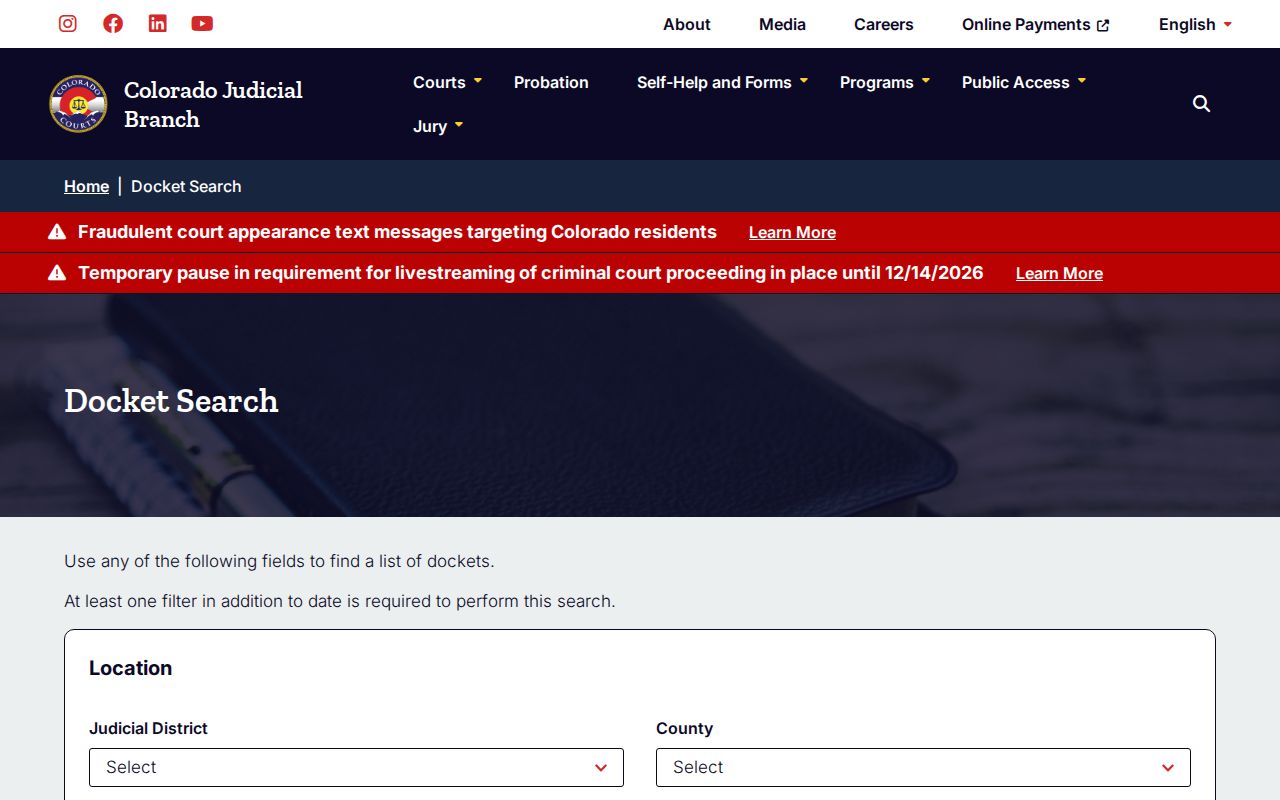
Need the hearing date or court division? The Colorado docket view can show both, though the Colorado court clerk still holds the actual warrant document and any current instructions.
Colorado's Warrant Calendar Is Not an Index
The Colorado Judicial docket search filters Colorado's published hearings by court location, date, case number, party, or attorney. A docket event labeled "Appearance on Arrest Warrant" points to a case event. It does not prove the order is still outstanding. A calendar can omit a matter with no public hearing entry, and an event may stay visible after the case changes. Use the entry to identify the Colorado court and case, then ask the clerk about current status. The same caution applies to a Colorado CBI criminal-history result. CBI's records FAQ says warrant status must come from the issuing agency at its discretion; a history check does not confirm whether a warrant exists. The CBI Most Wanted Sex Offenders PDF is a selected Colorado roster, not a complete warrant list. Neither tool stands in for the court and agency with jurisdiction. Note: A good result names a court or agency to contact, while the official custodian confirms the order and the next required step.
Colorado Warrant Search Results
Colorado has no uniform public warrant-record layout. A Colorado county sheriff portal may show only search instructions until a result comes back. The Colorado court docket may display a schedule and register-of-actions material, while a municipal portal can expose its own ordinance cases. The official record may hold more than a public page shows, and sealed or juvenile content may be withheld. Ask the Colorado custodian about those fields. Just do not expect every public search to display them.
| Case number | Use the court-assigned case or citation identifier to distinguish cases; no single statewide public warrant-number format is documented. |
|---|---|
| Party name | A Colorado result may pair a name with date of birth or other identifiers. Do not rely on a name alone when confirming your own case. |
| Issuing court | The public source may identify a Colorado municipal, County, or District Court, but some search tools expose less than the court file. |
| Order and date | Ask for the warrant or order document, entry date, issuing judicial officer, and the reason or event when those items are public. |
| Charge and case events | The docket may show a charge, court date, disposition, or later return/recall entry; public availability varies by case and system. |
| Bond and status | Colorado bond terms or labels such as active, served, recalled, or quashed are not displayed in a uniform statewide code set. |
A search result is just the start. Call the clerk and ask whether the entry matches the current court record. Ask too whether another agency must confirm service status. A local label like "outstanding" is ordinary language, not a verified Colorado-wide code. The Colorado court responsible for the case can tell you what actions it allows there, whether that means a motion, a hearing, bond, or a payment. Note: A local portal may report fields it does not share statewide, so confirmation should come from the Colorado court that entered the order.
Colorado Warrant Portals Have Narrow Scope
Colorado's local warrant portals each answer one narrow question. The Adams County Sheriff describes its list as limited to records held by that office. It excludes juveniles. It also warns that a blank result does not establish that no warrant exists. The page refreshes by 7 a.m. daily. Aurora's Municipal Court portal covers city matters and sends users to the court for confirmation. Denver County Court runs a bond search for Denver cases eligible for online bond posting, not for every warrant in Colorado. The Denver tool can help a person address certain local cases online. One case may offer options another does not. Its feature list includes case search and bond functions, including addressing a warrant, while the public bond form returns only cases that qualify for online posting. Denver's Bonding & Warrants Division handles questions about local cases. None of these local pages adds up to a statewide Colorado data feed or a single update schedule. The Adams County Sheriff warrant search page shows that office's local fields and scope notice without displaying any person's result. The separate Denver County Court bond portal carries its own eligibility limit and is not a statewide Colorado warrant list.
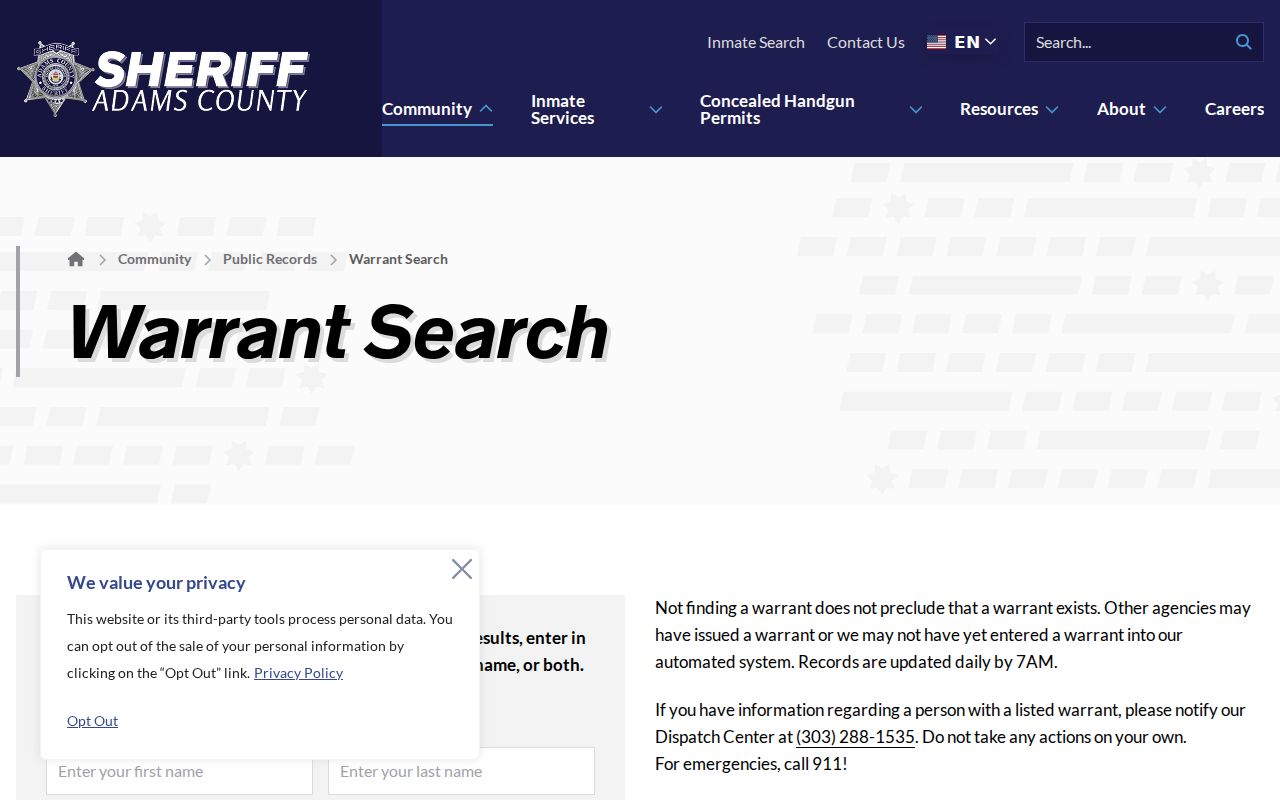
An empty county form proves nothing. Colorado warrant status still needs confirmation from the court that issued it and the agency with jurisdiction.
Colorado Warrants: Who Holds What
Who holds a Colorado warrant depends on the court named on the case paper. That court keeps the judicial order and the case history. A Colorado county sheriff may hold or serve a warrant. So may local police, a city marshal, state officers, or federal officers, depending on who issued it and who was assigned service. Colorado's statewide exchange moves justice and law-enforcement information between agencies. Its restricted records are not a public substitute for either office. For a Colorado County or District Court matter, use the state court location and Clerk of Court tied to the case. For a city-ordinance matter, contact the Colorado municipal court clerk and ask which local agency handles service. For a federal matter, PACER for the District of Colorado can show filed docket material, though it is not a public federal warrant-status service. The Colorado Judicial court locations page helps identify a courthouse, and Browse Counties routes to county sheriff and court contacts. Note: The Colorado issuing court can change its order; the service agency can explain whether it holds the order and how local service works.
Colorado Municipal Warrants Can Stay Local
A Colorado city-ordinance case belongs to the municipal court that issued it. Its record, hearing schedule, and warrant instructions may stay with the city court even though the city sits inside a county. A Colorado county sheriff search may not include it. A Colorado state-court docket will not necessarily show its local status. If the ticket names a city court, start there. Assuming a county or state search covers the case is a common mistake. State-law cases follow a different path. County Courts hear misdemeanors and traffic matters within their jurisdiction. District Courts are the general-jurisdiction trial courts and handle felonies. A municipal citation and a Colorado state-law traffic citation can grow from the same conduct yet sit with different custodians. The Colorado court location and case type decide which clerk can pull the order. Aurora's official warrant page describes its city portal and supplies court contact routes. It also separates municipal business from Colorado state traffic or criminal cases filed in County Court. That local example shows why jurisdiction matters, not a promise of statewide coverage. Follow the court name on the citation. Use the Colorado county directory when the case belongs to state court.
Which Colorado Warrants Stay Restricted
Not every warrant record is open to a name search. Colorado's court access rules, the custodian, the case type, juvenile status, sealing orders, and investigative context all shape what appears. The Colorado Judicial public-facing court guide says the Branch does not provide direct public access to court records through its website. It sends people to the filing court instead. Law-enforcement records get evaluated under the Colorado Criminal Justice Records Act. An agency's holding a record does not make it automatically public.
Access limits: Colorado juvenile records have statutory restrictions under C.R.S. §19-1-304, and sealed records or orders may not appear in an ordinary search. CJD 05-01 sets public-access categories for Colorado court records. An empty Colorado county list, docket, or local portal is not proof that no warrant exists; confirm directly with the court and responsible service agency.
Colorado CORA and Colorado CCJRA govern records held by state and local agencies. A request can be denied or redacted. The custodian should identify the decision process that applies. A records request does not recall a warrant or excuse a court date. The Colorado Judicial access guide explains the official court-record route and separates court-file access from law-enforcement record access.
Request the Official Colorado Warrant Record
The Colorado Judicial Branch offers a Record/Document Request Form when you cannot view a court record directly. You supply a primary party name and your contact information, and the form gives you fields for a case number, case type, filing year, court or county, date of birth, and other identifying details. There is even a checkbox for requesters who do not know which Colorado county the case sits in. You can also name the kind of Colorado court document you need, whether that is a complaint, disposition, ticket, or another listed record. The Judicial Branch generally responds within three business days unless circumstances are extenuating, and the fee schedule is spelled out plainly. Ordinary copies run $0.25 per page, capped at $15 for a party or attorney, with no maximum for a nonparty. A transcript judgment costs $25, a satisfaction certificate $20, and a certified or exemplified copy $20. A name search is $5, offsite retrieval is billed at actual cost, and research or redaction beyond the first hour runs $30 per hour. None of that is a warrant fee or a bond, so do not treat it as one. The blank request form shows the Colorado court's official fields and document categories, and any request with private details belongs in that official channel alone.
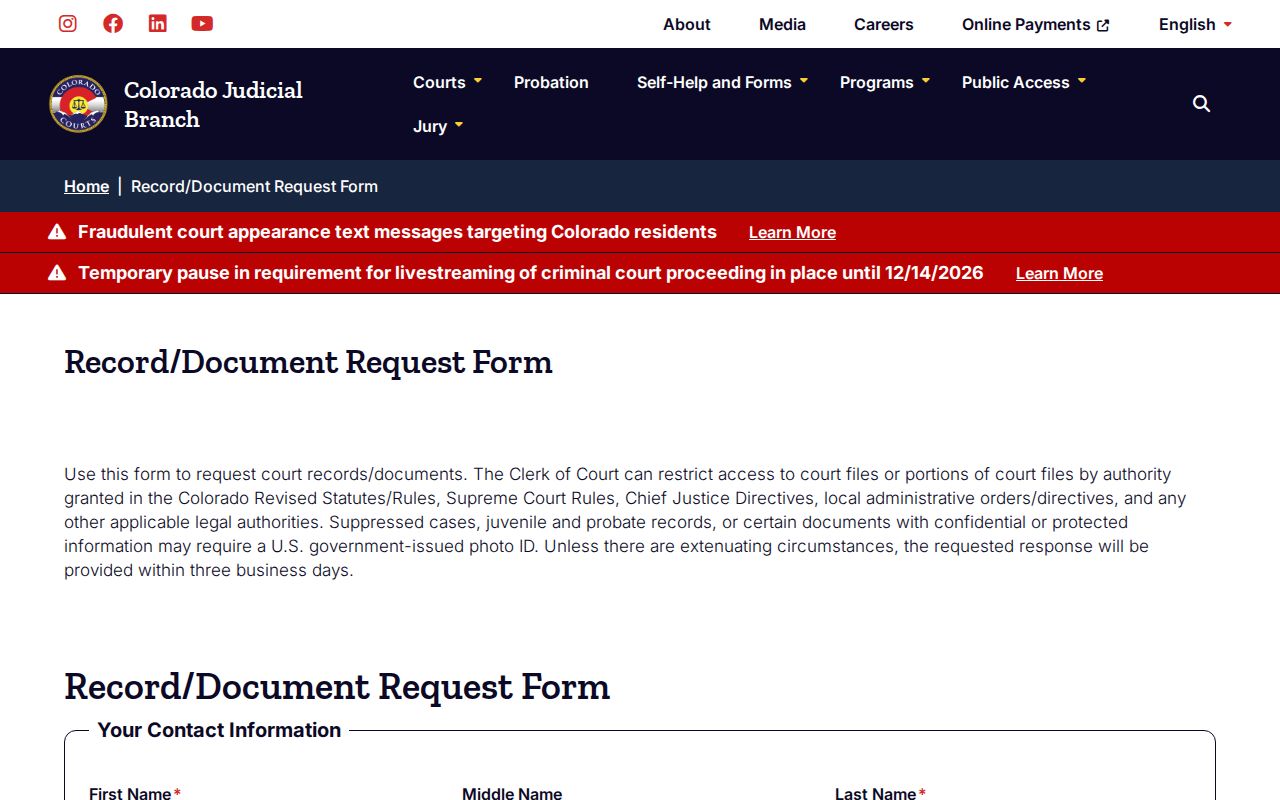
A Colorado court document request only retrieves a record. It does not ask a judge to recall or quash a warrant. For sheriff-held information, contact the correct Colorado CCJRA records custodian and confirm the court's next step separately.