
Outstanding Warrants in Colorado
“Active” and “outstanding” both describe one thing: a warrant that has not been served, recalled, or cleared. Colorado publishes no statewide roster of these orders. Each one lives in the case record of the Colorado court that issued it. A sheriff, a municipal police agency, or another law-enforcement office may then be tasked with service. Nothing merges those files into a single public warrant search just because the case began in Colorado. A state-system entry is not a public warrant record either. CICJIS moves data among justice agencies, while CCIC, NCIC, and related systems are closed to anyone but authorized users. Checking on your own matter means finding the Colorado court named on a citation or notice. Contact that court first. Then reach the agency handling service. If you cannot tell where the case sits, the Colorado county directory can route a state-court matter to the right local court and sheriff office. A city citation, though, points back to the municipal court that issued it.
Colorado Has No Public Warrant List
No Colorado state agency, Judicial Branch site, or sheriff association page offers a public search of every active warrant. The Colorado Judicial Dockets tool covers a hearing calendar, not every open order. A criminal-history check from CBI is a different product; the CBI records FAQ says the issuing agency itself must answer warrant-status questions. The CBI Most Wanted Sex Offenders PDF is only a selected roster. Beyond that, Colorado county sheriff portals vary widely. Some post a form, some confirm by phone, and some send you to another office entirely. Colorado's restricted data exchange serves justice and law-enforcement users, never public name searches. A hit on one local page therefore describes that page's stated jurisdiction and no one else's. A blank result carries the same limit. It may mean the record sits with a municipal court, was just entered, is sealed, or simply is not online. Current status comes from the Colorado issuing court and the office tasked with service.
Do not infer statewide clearance: Colorado has no public statewide warrant roster, so an empty county search or court calendar cannot establish that no active order exists.
The Colorado Active-Warrant Picture
Every official source here has its own job. The Colorado issuing court can confirm its order and the next court step. A Colorado sheriff's warrant unit can say whether that office holds the warrant for service and what its local surrender process requires. A Colorado municipal court handles city cases, with city police or a marshal arrangement handling service. There is no single public phone line and no universal bond schedule for active warrants in Colorado. Access then depends on the record holder and the case. Court material follows Colorado Judicial access rules, including Chief Justice Directive 05-01. Criminal-justice records kept by law enforcement fall under the Colorado Criminal Justice Records Act, while general state and local agency records may fall under CORA. None of these laws turns a restricted system entry into public data or puts every court record online. Ask the holder for the official record, and ask the reason if an item is withheld. The official Colorado Judicial access guide says the same thing: direct public access to Colorado Judicial records is not provided through its website, and it sends people to the court. That instruction matters when a calendar search is all you can see. A docket event can help you locate a case, but only the clerk can confirm whether the warrant remains in effect.
Note: Colorado court calendars expose hearings, while a current warrant-status answer comes from the issuing court and service agency.
Colorado Warrant Lists Set Their Own Scope
Colorado has no single format for its public warrant lists. Each county builds its own tool. The Adams County Sheriff's search accepts a first name, last name, date of birth, or warrant number, and it permits partial name entries. Its scope notice limits the list to records that sheriff holds. Refreshes happen daily by 7 a.m. A result is reference information only. A blank result does not establish that no warrant exists. Those are Adams County's stated conditions, not a statewide Colorado rule. Some Colorado sheriffs prefer the phone. Jefferson County's official warrant page asks callers to have a full legal name and date of birth ready. A municipal portal may cover only city ordinance cases. Denver County Court's public bond portal searches by name and date of birth or by case number, yet it returns only cases eligible for online bond posting. Colorado has no common county feed. No shared public update cadence exists either. Never carry one local timestamp to another Colorado court or sheriff. The blank Adams County search page shows that sheriff's fields and scope notice without displaying any person's result.
Active Warrants: What They Show
Colorado public portals use no uniform field set. A local result may show the subject, case, court, charge, bond, status, or serving agency. Not every portal displays all of those items. An empty form reveals only its search inputs, not the layout of a single record. The record itself stays hidden. Treat a displayed field as unconfirmed until the Colorado clerk of court confirms it.
| Identifier | Case, citation, or warrant number may help distinguish records; Colorado has no common public statewide warrant-number format. |
|---|---|
| Person match | A Colorado name may be combined with date of birth or other identifiers; check the issuing court before assuming two records refer to the same person. |
| Issuing court | A Colorado local record may identify a city, County, or District Court, but no statewide public court-location field is established. |
| Order and reason | Ask for the warrant document, entry date, reason, and later service or recall entry if public and available. |
| Bond or status | Bond terms and words such as active, outstanding, served, recalled, quashed, or canceled vary by local system. |
Status words are plain labels, not a verified Colorado-wide code. A current Colorado court order may not show on a local public page. A local entry can lag behind the action. Ask the Colorado clerk what the label means in that case. Also ask whether the sheriff, city police, or another assigned agency must update its record.
Why Colorado Search Results Miss Warrants
A blank result on a county list proves very little. A Colorado sheriff's page may leave out a city case, an order from another county, a fresh entry, or a juvenile matter that officials keep offline. No statewide public list exists to close those gaps. A Colorado court calendar deserves the same caution, since it tracks hearings rather than the live status of a warrant. If your search turns up nothing, take the notice or case paper and call the Colorado Clerk of Court that issued the warrant. That one call can answer the questions a list cannot: whether the Colorado warrant is still active, which agency handles service, whether bond or a court appearance is required, and whether the judge has set a new date or issued a recall. Lost the paperwork? Start where the Colorado case was filed, in the county or city of the original charge, and use official court locations to find the right clerk. Skip the search vendors and the old saved copies of pages. Neither one can tell you where the Colorado warrant stands today; only the issuing court can.
Note: Colorado's public-access limits and local system boundaries mean a blank public result cannot confirm that a warrant was recalled, served, or never issued.
Colorado Warrant Roundups
Colorado's best-known roundup comes from the state itself. The Colorado Bureau of Investigation publishes a Most Wanted Sex Offenders PDF. It is a selected statewide program roster, not a searchable active-warrant list. The January 2026 edition states no refresh schedule, county coverage map, reward amount, anonymity guarantee, or universal status filter. Tips go to 303-239-5732 or CDPS_CBI_FugitiveTips@state.co.us. Use that official channel only. Do not approach a person listed there, and do not treat the PDF as an individual warrant check. Some Colorado counties run their own curated programs. The Douglas County Sheriff Most Wanted program publishes a local tip contact and says a tip may be left anonymously. That program sits apart from the CBI roster and from the county's full warrant-status channels. A roster entry is not a complete Colorado warrant search. Tip lines take leads, not status requests. The Colorado county directory points to each local route, and State Most Wanted explains the difference between curated lists and a full search.
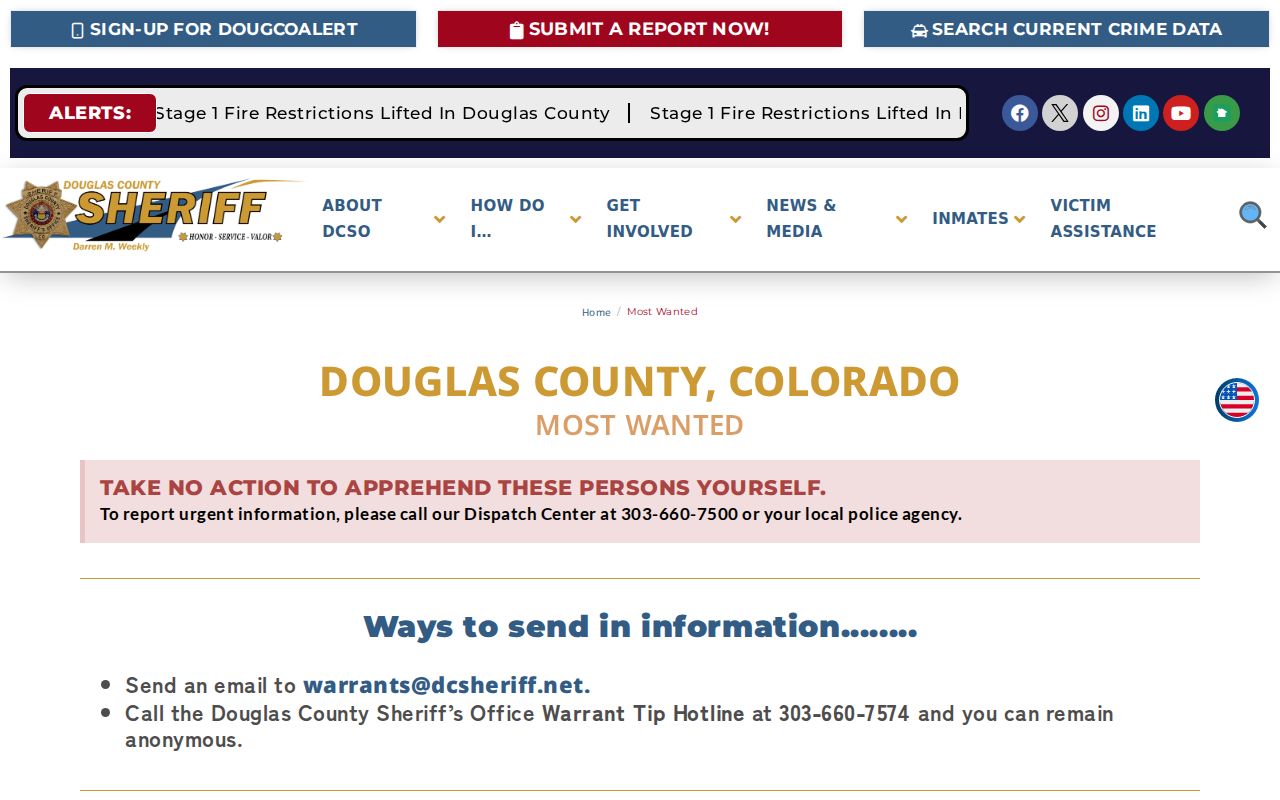
The program header and tip route are local information. They do not replace a Colorado court or sheriff confirmation of a specific order. Event eligibility rests on one court notice and date. Note: Colorado prior participation rules do not carry forward, so rely on the specific notice.
Colorado Warrant Clearance Days Are Local
Colorado sets up no statewide warrant-amnesty week, no hotline, and no uniform fee-waiver program. Warrant clearance events are purely local. Judicial districts and counties announce their own clearance days, and each Colorado notice carries its own date, court location, eligible case classes, and exclusions. Such an event can open a door. It promises no dismissal, and it never covers every active warrant. The Fifth Judicial District once advertised a Summit County Combined Courts event for September 19, 2026, and Colorado Judicial announced Denver-metro clearance days in April and May 2026. Those dates belong to past notices. Eligibility also differed by district in each release. Watch the Colorado Judicial press-release archive and the issuing Colorado court for anything newer. An old notice is not a program schedule. The official September clearance notice records its date and eligibility terms. It stands as one dated local example, not an open offer.
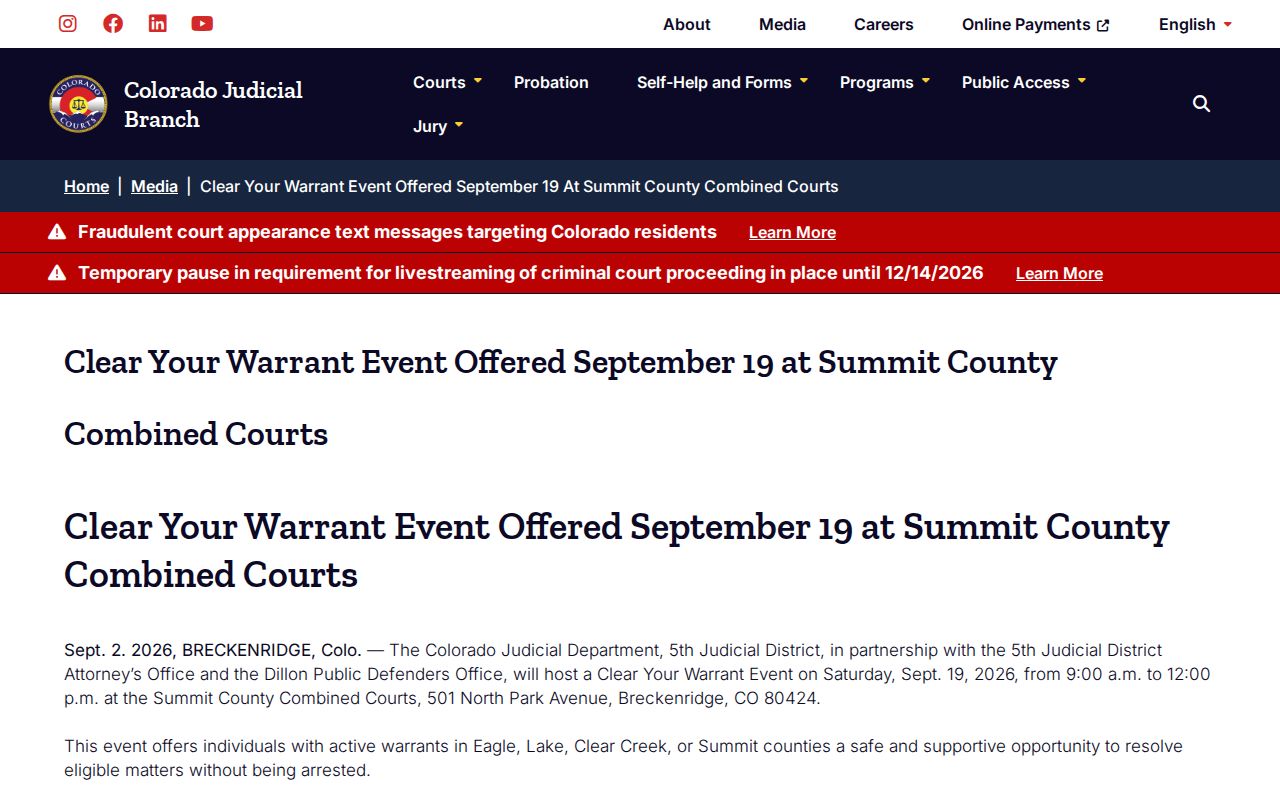
Call the Colorado court named on the new notice before attending. Confirm the case number, eligibility, required documents, and whether a new hearing date or bond remains due. Do not rely on the flyer alone.
Finding Your Own Name on a List
Finding your own name on a Colorado warrant list is a reason to act, not a resolution. Match the listed court to your case paper. Then call the Colorado Clerk of Court. Ask whether the warrant is still open, what event led to it, whether a hearing or motion is available, and whether bond has been set. The sheriff or serving agency may hold the order. Ask that office what surrender steps apply. Municipal cases go to the Colorado city court. A name dropping off a public list does not mean the Colorado court recalled its order, so get any recall, payment, bond, or new-date instruction in writing. Then ask how the court and the agency will confirm the record update. Uncertain about appearing, surrendering, or filing a motion? A lawyer can weigh those choices with you. Colorado's court records request form can supply case documents. But a request does not change the warrant or pause a required date. Use Browse Counties to find the right Colorado county court and sheriff. A federal matter belongs to the U.S. District Court, not to any Colorado state or county list treated as a status check.
Colorado Warrant Access Rules Limit Records
Not every Colorado warrant record is open to the public. Case type, sealing, juvenile confidentiality, or the reason police hold the record can all restrict it. Colorado's Chief Justice Directive 05-01 sets the court-access categories. C.R.S. §19-1-304 limits access to juvenile records. The Colorado CCJRA lets a criminal-justice records custodian decide access to law-enforcement material, so a public list's scope and your right to request a Colorado record are separate questions.
- Active or outstanding
- Ordinary terms for an order not shown as served or recalled; Colorado has no shared public status-code list.
- Recall
- A court action withdrawing or canceling its warrant, often after a motion, appearance, or other required step.
- Sealed record
- Material withheld from ordinary public access by statute, court order, or court rule.
- Juvenile record
- Youth-related court or justice information subject to statutory confidentiality limits.
Colorado court records come from the filing court under the applicable Judicial access process. Sheriff-held items go to that agency's Colorado CCJRA custodian. CORA may govern other state or local records. If a custodian withholds a record, ask which rule applies. A Colorado request can still obtain an official document. Only the issuing court can recall its warrant. Note: In Colorado, a restricted or juvenile record can be legally absent even when the search route itself is official.