
How Colorado Warrants Are Tracked
Every Colorado warrant starts as a Colorado court case. District Court judges and magistrates issue warrants in felony matters and anything else within their authority, County Courts handle limited criminal and traffic cases, and a municipal court can issue a municipal warrant for a city-ordinance violation. The Clerk of Court at the right Colorado location keeps the court record. In a city case, the municipal clerk holds that file. Service then falls to the county sheriff, municipal police, or another authorized agency. Above those local pieces sits a statewide layer, but it is an information exchange rather than a public warrant repository. CICJIS, the Colorado Integrated Criminal Justice Information System, links participating justice agencies. The Colorado Bureau of Investigation runs the Colorado Crime Information Center, CCIC, and supports authorized access to national systems. There is no public statewide active-warrant query. Colorado counts 22 judicial districts and 64 counties, and those figures map court and county structure, not public-search coverage. So a practical Colorado warrant check still runs through the local offices. Identify the issuing court first. Ask the Colorado clerk for the record. Then confirm service status with the agency assigned to act on the warrant. Use the Colorado county directory to reach the right local court and sheriff information.
Colorado's Five CICJIS Partners
Colorado Judicial describes CICJIS as a cooperative system with five Colorado partners. They are Colorado Judicial, the Department of Public Safety and CBI, the Department of Corrections, the Colorado District Attorneys' Council, and the youth-corrections function. The Colorado Judicial page explains how the exchange supports connected justice work, including court-to-CBI warrant information and notices that a warrant has been served. Those functions move data. They do not open the network to the public, and no universal list of every Colorado warrant exists for viewing. The five-partner count describes participating institutions, not county feeds or municipal courts. Colorado public material names no complete agency roster beneath that level, states no rule that every warrant class is transmitted, and publishes no entry-and-removal timetable. Meanwhile, local agencies keep their own systems and records. A county, city, or court may follow its own workflow for a given order. So the existence of CICJIS tells a reader nothing about whether an individual Colorado record has been entered, synced, or removed.
The Colorado Warrant Database
Colorado offers no public statewide warrant database. Several systems support authorized justice work, and each plays a distinct role. None doubles as a lookup anyone can run. The table below separates the Colorado court-to-agency exchange from state and federal criminal-information systems, so a system name is never mistaken for a public portal.
| System | What It Holds or Exchanges | Run By |
|---|---|---|
| CICJIS | Colorado interagency justice information exchange, including described warrant transmission and service notifications | Five Colorado justice partners |
| CCIC | Restricted Colorado criminal-justice information, including warrant records used by authorized agencies | Colorado CBI Crime Information Management Unit, CDPS |
| NCIC | National law-enforcement index for eligible Colorado records entered through authorized channels | FBI, with access by authorized Colorado users |
| Nlets | Interstate law-enforcement information exchange supported through Colorado's CJIS interface | Colorado CBI supports state access |
None of these entries is a public name-search tool for warrant status. A restricted system can share information among authorized agencies while the underlying court order stays a local case record. A blank result anywhere is not statewide clearance either. For your own current case, the answer comes from the court and serving agency, not from a search of these systems.
CCIC and NCIC Are Restricted, Not Public Search Tools
Colorado CCIC, NCIC, and related interfaces exist for authorized criminal-justice users. The public cannot run them as a self-service Colorado warrant lookup. Nor can an entry in a restricted system be confirmed through a criminal-history result, a court-calendar result, or a missing name on a sheriff's page. Colorado CBI's online Criminal History Record Check is a separate service. Its FAQ states plainly that the check provides no warrant information and points the requester to the issuing agency, at that agency's discretion. A name-based report answers a different question about Colorado repository records. It is not a clearance letter for a court order. CBI administers Colorado information systems and investigative support. It does not adjudicate a case, set bond, cancel an order, or decide whether a warrant remains active.
CBI records-check FAQ
The official FAQ distinguishes criminal-history checks from warrant-status confirmation and points readers back to the issuing agency.
When court papers, a public portal, and a phone answer disagree, go back to both. Ask the issuing court and the agency holding the warrant for service to reconcile the current record. Only the issuing Colorado court can change its order.
From County Warrant to Statewide Index
In Colorado, a warrant begins with judicial action, not with a public search form. A judge or magistrate signs the order. The Colorado Clerk of Court keeps the court-side record. The sheriff or another law-enforcement agency may then receive the Colorado warrant for service. Colorado Judicial describes warrant data moving to CBI through the interagency environment, with service notifications returning to the court. Authorized agencies use Colorado, state, and federal systems according to their role and the applicable rules.
Warrant flow: Issuing court and Clerk of Court › serving sheriff or police agency › CICJIS and CBI/CCIC exchange › NCIC entry where authorized and appropriate › service information returned through official channels.
This picture describes documented Colorado system functions. It does not guarantee that every county or municipal warrant follows the same path. No public source maps Colorado county-by-county participation. Warrant-type coverage and update delays go unpublished too. A Colorado city-ordinance case can stay entirely inside a municipal court and its local agency workflow. Confirm the order with the Colorado court that issued it and the agency charged with service.
Colorado's CICJIS Shares Warrant Updates
Colorado Judicial's CICJIS overview describes the Colorado system as an information exchange among justice partners. The page explains integrated data sharing. It also links Judicial case tracking to CICJIS participation. That helps in understanding Colorado agency connections. It offers no individual Colorado warrant search, no searchable status fields, and no public completeness guarantee.
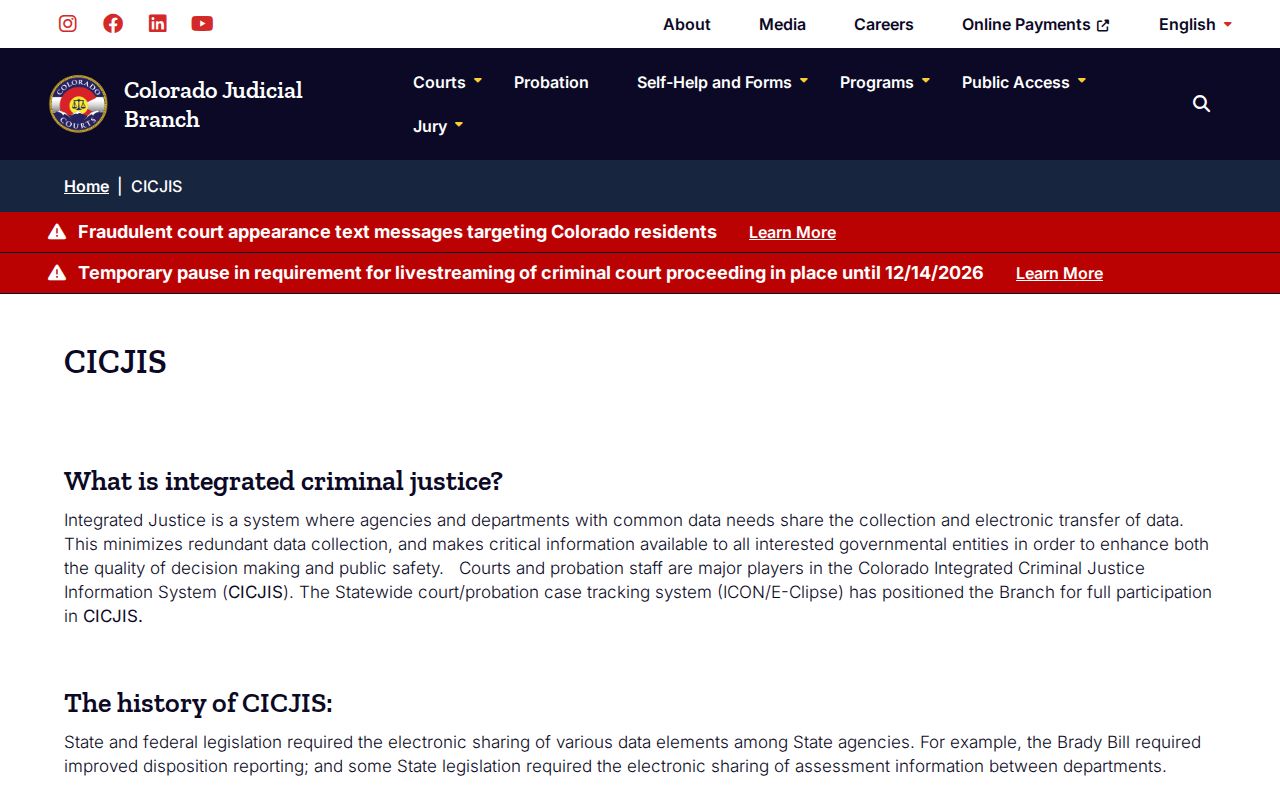
The official page from Colorado Judicial offers system and agency context. It does not confirm that a particular Colorado warrant is present or current. The documented exchange carries Colorado warrants and restraining orders from Judicial toward CBI. Warrant-served notifications flow back the other way. That two-way loop lets the Colorado architecture support both a court record and an agency status update. Nothing is published about sync speed. Never assume a same-day update. Ask the court and the serving agency before assuming any particular Colorado county's coverage, since a local record may move at its own pace.
Federal Fugitive Warrants in Colorado
Colorado sits inside one federal judicial district, the U.S. District Court for the District of Colorado. Federal warrants come from federal judicial process. They live in federal court records, not in any Colorado state system. The U.S. Marshals Service executes them and may work alongside Colorado state or local agencies through a fugitive task force. A Colorado county portal is not the federal system. No Colorado state court can recall a federal order. The U.S. Marshals District of Colorado lists offices in Denver, Colorado Springs, Durango, and Grand Junction. Public PACER access covers available docket entries and documents. It is not an all-active-warrant list. A sealed warrant or a record not yet public may not appear. The Colorado District Court puts PACER's general charge at ten cents per page. A document cap applies, and quarterly charges of $30 or less are waived. Check the Colorado court's current access terms first. The U.S. District Court for Colorado's PACER access page explains federal docket access and general fees, but the system is case-record access, not an active-warrant search.
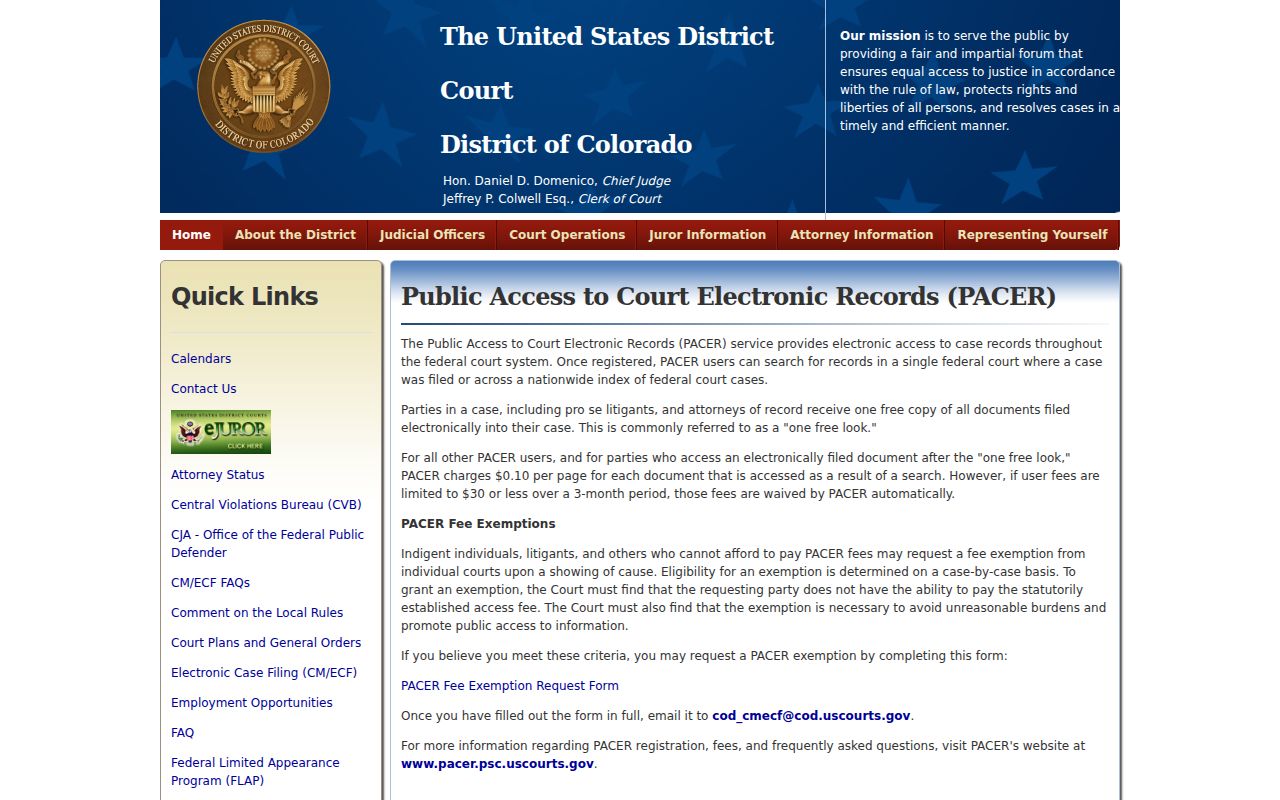
The Colorado court page explains PACER access. A docket query still cannot confirm an unfiled or sealed federal warrant.
| Question | Colorado State or Local Warrant | Federal Warrant |
|---|---|---|
| Issuing court | District Court, County Court, or municipal court as jurisdiction allows | U.S. District Court for Colorado |
| Case record | Clerk of Court at the issuing location or city court clerk | U.S. District Court Clerk and available CM/ECF docket |
| Service | County sheriff, local police, or another authorized agency | U.S. Marshals and other authorized federal officers |
| Public access | No public statewide warrant search; confirm locally | PACER docket access, not an active-warrant search |
Colorado Violent Offender Task Force Results
The Colorado Violent Offender Task Force is a U.S. Marshals-led partnership for selected fugitive investigations. Its public description stresses cooperation with Colorado agencies. It does not claim that every Colorado county warrant is assigned to the task force. The task force is an operational channel. It publishes no public roster and no Colorado statewide warrant-search service. A Colorado USMS report issued February 4, 2026 tallies the task force's 2025 work. It recorded 498 fugitive arrests. It also cleared 566 active felony warrants in Colorado during 2025. The report lists the Colorado state, local, and federal agencies taking part, plus deputized task-force officers. Those numbers belong to this Colorado task force alone. They are not statewide totals for warrants or arrests. Arrests and warrants are separate measures, since one arrest may clear more than one warrant. The official Colorado task-force program page describes that role. The 2025 Colorado results release supplies the dated counts. Neither tool checks an individual case, so a person seeking federal case information should use the Colorado federal court's PACER access page and remember its limits as docket access rather than warrant confirmation.
U.S. District Court for Colorado: PACER
Federal court instructions explain how to access available docket material and the court's general PACER fee rules.
Statewide Index vs Colorado County Warrants
A Colorado system index and a local court order answer different questions. Statewide and national systems are restricted to authorized Colorado users. No public statewide active-warrant search exists. The official record sits with the issuing Colorado court. The agency assigned to serve the order confirms its own current information. No exchange or county list replaces the other.
| Feature | State or National System | Issuing Court and County Agency |
|---|---|---|
| Public access | Colorado CCIC, NCIC, and CICJIS are not public lookup tools | Colorado public court records and sheriff contacts vary by jurisdiction |
| Primary role | Authorized exchange or index of Colorado criminal-justice information | Maintains the Colorado order, case details, and local service status |
| Coverage | Public coverage, warrant classes, and reporting intervals are not fully documented | Local portals cover only the records their agency chooses and is allowed to publish |
| Recall or correction | System entry does not change a court order | The issuing court changes or recalls its order; agency updates service records |
| Reader route | No public statewide warrant query is available | Use the county directory and contact the issuing court and serving agency |
A blank public result only reflects that channel's limits. It does not prove that no warrant exists. Confirm any Colorado record directly before acting, especially when a court notice, an agency response, or a federal matter points to a different jurisdiction.
The 2013 Colorado Warrant Profile Is Historical
A National Center for State Courts profile from 2013 sketches the Colorado Electronic Warrants System as a link among Colorado Judicial, CBI, and CICJIS. In that Colorado design, the court ICON case management system fed through CICJIS middleware into CBI's Warrants System in CCIC. Status synchronization then flowed between the court side and CBI. The paper is a useful map of the plumbing behind Colorado's exchange. That is all it is. Treat the word "system" in a 2013 technical profile as architecture, not as a public website. The document offers no Colorado service directory. It names no 2026 roster of participating counties, no complete list of warrant classes, no present-day data backfile, and no public search field. Newer public descriptions still credit CICJIS and Colorado court systems with the exchange, and they stop there. Nobody publishes a full current technical map. Nobody promises that every local order gets entered. A Colorado court order still starts at the local issuing court, whatever an old profile implies about synchronization. When an entry looks missing, stale, or unclear, the person affected should call the Clerk of Court and the serving agency. That call answers more than any inference drawn from a 2013 diagram ever could.
How Colorado Warrant Systems Went Digital
Colorado built its justice-data exchange in stages, through legislation, funding, and phased rollout. The milestones reflect agencies wiring shared infrastructure together. None of them opened a public statewide warrant search, because Colorado designed the system for interagency exchange rather than direct public queries.
- HB95-1101 established the legislative origin cited by Colorado Judicial for CICJIS.
- SB96-221 funded implementation, and system design began in July 1996.
- Basic CICJIS infrastructure went statewide on May 4, 1998.
- A 2013 National Center for State Courts profile later documented the Colorado Electronic Warrants System connection among court case management, CICJIS, and CBI's CCIC warrant system.
Colorado Judicial describes warrant and restraining-order data flowing toward CBI, with warrant-served notifications flowing back to the court. CBI's Crime Information Management Unit keeps those Colorado state and federal interfaces running. Call it an evolution in authorized data exchange. It did not replace Colorado local court records, and it never created a public database holding every active order. The public access boundary still stands. Colorado's Judicial Branch says plainly in its access guide that court records are not directly searchable from its website, though public docket calendars and record-request forms exist for narrower purposes. A docket event is not a warrant record. For the actual order, the bond, current status, or recall, contact the court and the serving agency. The Colorado county directory then points you to the right local channels. Colorado built pipes between agencies, and the public door into a warrant question still opens at the courthouse.
Colorado OJW: A Narrower Warrant Record
Colorado uses "Outstanding Judgment/Warrant," or OJW, in one narrow setting: traffic and driver records. It is not a generic label for every active Colorado warrant, and it creates no statewide failure-to-appear search. No public Colorado lookup covers traffic FTAs or license holds. The traffic case stays with the court. The driver record lives in the motor-vehicle system. HB21-1314, effective January 1, 2022, narrowed the license effect of a specified Colorado OJW: it cannot by itself be the reason to deny issuance, renewal, or reinstatement of a Colorado license. The change did not erase the underlying case, dismiss a warrant, or settle a balance. Pre-2022 records may still need direct review by the Colorado court and DMV. The Judicial fee schedule lists a $30 OJW court-fee line under the cited statutes. That figure is not a general warrant clearance price or a statewide search fee. Someone with an OJW question should ask the reporting court what remains due and whether any court order exists, then ask DMV about the separate driver record. City-ordinance cases belong in municipal court. Database names alone cannot answer every public question, and this split between court and DMV records is exactly why.