
Colorado Arrest Warrants Begin with Probable Cause
Every Colorado arrest starts with paperwork: a complaint or an affidavit laying out facts for a judge to weigh. Under C.R.S. §16-3-108, an arrest warrant requires a probable-cause showing. That decision belongs to a judge or authorized magistrate. A police report cannot create one. A prosecutor's filing cannot either, and a sheriff's search page issues nothing. In Colorado, the judicial officer alone decides, applying the criminal procedure rules that fit the case. Probable cause simply means facts supporting two beliefs: that an offense happened and that the named person committed it. What the affidavit says may differ from what the public docket shows, since a Colorado case file can be treated differently from public view. A sealed order may stay hidden even before service. Keep the frame straight: a warrant belongs to its case and its issuing court. Note: Issuance is a judicial act; a police report or a public search result is not itself a Colorado warrant.
How Arrest Warrants Work in Colorado
An arrest warrant gives officers the power to take someone into custody on a criminal matter. In Colorado, a judge or magistrate issues one only after reviewing the complaint or affidavit and finding the legal basis. The path varies with the charge and the posture of the case. Felonies in Colorado generally move through District Court. Misdemeanors often land in County Court. City ordinance cases go to the municipal court that handles them, and knowing that tier tells you which clerk to call. Colorado procedure also allows a summons, which directs a person to appear rather than authorizing an arrest. Serving a warrant does not resolve the charge; the case continues. After issuance, the Colorado court record may show later events, such as service, a return, bond conditions, or a recall. What appears publicly varies by court. So confirm the case itself before trusting any search result.
Colorado Felony and Misdemeanor Warrants Use Different Courts
Court level is the first clue in any Colorado arrest warrant search. Colorado District Courts are the general-jurisdiction trial courts, and felonies land there. Colorado County Courts handle many misdemeanor and traffic matters within their statutory role. A municipal court takes the local ordinance cases, which stay separate from state criminal cases even when the events occurred in the same city. Colorado organizes this work across 22 judicial districts, and County Courts serve the state's 64 counties. Those are organizational counts, not tallies of active warrants. The state publishes no statewide municipal court total either. Match the case to its court with the case paper, the citation, or a court calendar, then check Colorado Judicial court locations to find that court's Clerk of Court. The county directory helps route state-court matters to local contacts, and the clerk on the other end can confirm whether an order exists.
Arrest Warrants: What They Contain
No single statewide listing spells out a standard set of warrant fields in Colorado. A court's file may hold case identifiers, the order itself, and later docket entries, but public portals vary widely. The official Colorado Judicial record request form shows what a clerk needs: a case number, court or county, case type, year, primary party name, and other identifying details. Gathering those details speeds up the request. It does not promise every field appears on every warrant.
| Case and Court | Case number, case class, filing location, and issuing court may identify the Colorado record. Colorado has no verified statewide warrant-number format. |
|---|---|
| Named Person | Name and sometimes date of birth or other identifiers can help distinguish people with similar names. Do not rely on a name alone. |
| Charge or Offense | The case record may show the charge or offense connected to the warrant, subject to access limits. |
| Order and Date | The warrant document, entry date, and issuing judicial officer may be available in the court file. |
| Bond or Conditions | Bond amount or release terms may be set and public, but a current amount may require direct court or jail confirmation. |
| Service or Status | A local record may show a return, service, recall, or status entry. Colorado has no uniform public status code list. |
A blank field never proves Colorado skipped issuing the order. Ask the court instead. The record may be restricted, filed under another case number, or available only through a formal request.
A Sealed Colorado Arrest Warrant May Not Appear in Search
Colorado treats some court files as sealed or restricted. A sealed warrant or indictment stays out of public view until an arrest occurs or a judge orders it unsealed. Juvenile records carry their own confidentiality rules under Colorado statute. So a blank result does not prove that no Colorado warrant exists. The gap could be a sealed file, a protected record, or a different Colorado court. Some public sites never display the record at all. The Colorado Judicial public access guide states that court records are not directly searchable from its website and points requesters to the filing court for anything official. For a copy or an access decision, use the Record/Document Request Form or contact the Clerk of Court. That kind of request only seeks documents. It does not ask the judge to recall the warrant. The Colorado Judicial docket calendar presents blank search controls for filtering court calendars. Those filters can locate a calendar entry only. The calendar itself is not a warrant-status index for Colorado cases.
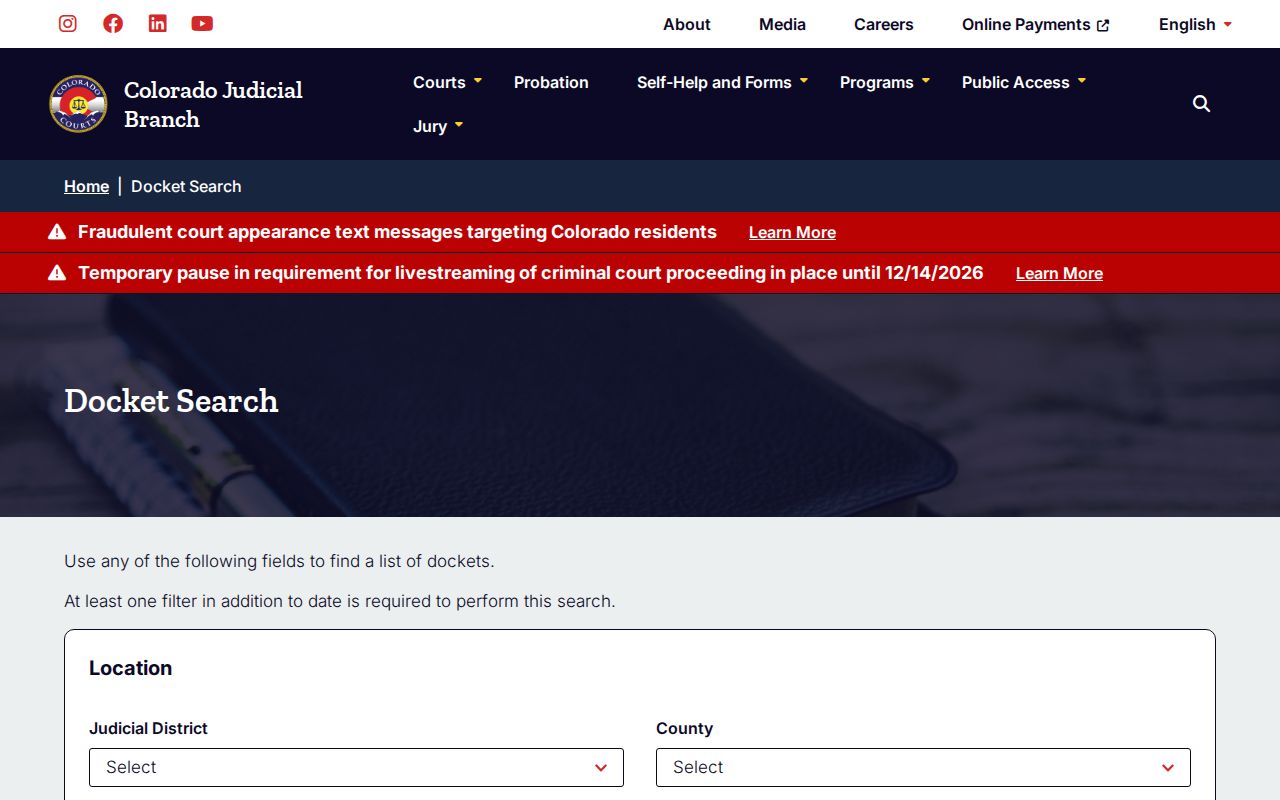
A Colorado docket calendar entry can flag a hearing event. Then ask that court about the order and its official record. Note: Colorado’s access guide separates official court records from data products that may be incomplete or contain errors.
How Warrants Get Served in Colorado
Who serves a Colorado warrant depends on the case. A county sheriff or a city marshal can execute it. So can municipal police, the Colorado State Patrol, other authorized state officers, and federal partners when the matter calls for them. Jurisdiction drives the assignment. The Colorado State Patrol is a state law-enforcement agency. The Colorado Bureau of Investigation supports justice information and investigations. CBI manages CCIC infrastructure. It never issues, recalls, or publicly confirms a warrant. Once an officer executes a Colorado arrest warrant, booking, the initial appearance, advisement, and bond all depend on the charge and the court. Colorado sets no single statewide promise that every person sees a judge within one fixed number of hours. The issuing court’s Clerk of Court keeps the case-side record. The assigned agency can confirm service or surrender logistics. One Colorado warrant can involve several offices, so ask which agency holds the order.
After a Colorado Arrest Warrant Is Served
A Colorado warrant changes custody status once served. The criminal case in Colorado remains open. The court’s order controls what comes next. The person may be booked, brought to an initial appearance, and advised of the charge. Bond or release conditions may follow. A judge can set or revise those terms, or order a hold under the law that applies. No universal Colorado bond amount exists, and no fixed timing promise covers every warrant. Once the order is confirmed, ask the Colorado court clerk what hearing or filing comes next. Ask the assigned Colorado sheriff or police agency where surrender or booking happens. If a bond amount appears on a public record, confirm it is still current before relying on it. Keep the signed release or recall order, the bond receipt, and the next court date together. A missed date can create a new court problem. It can also expose the bond to forfeiture. Follow the written Colorado court terms. Note: A bond can secure release or an appearance, but payment alone does not dismiss the case or guarantee recall.
Arrest Warrants, Summonses, and Bench Warrants
These Colorado court papers are not interchangeable. An arrest warrant authorizes custody through the applicable probable-cause process. A summons is different. It directs a person to appear in a Colorado court without ordering an arrest. A Colorado bench warrant grows from a pending case. It often follows a missed appearance or another court-directed basis. It can authorize arrest too, but its trigger and setting differ from a new arrest warrant. The Colorado bench warrant lookup covers that separate process.
| Feature | Arrest Warrant | Summons | Bench Warrant |
|---|---|---|---|
| What It Does | Authorizes arrest in a criminal case. | Requires a person to appear, without itself directing custody. | Addresses nonappearance or another court order in a pending case. |
| Why It Issues | Colorado judicial officer finds the statutory probable-cause basis. | Used when process calls for a Colorado court appearance by notice. | Depends on the case type and the Colorado court’s authority. |
| Who Controls It | Colorado issuing judge or magistrate and court. | Issuing court or authorized officer under the applicable rule. | Judge or court handling the pending case. |
| Next Step | Confirm status and ask the Colorado court about appearance, counsel, surrender, or bond. | Appear by the stated date and follow the notice. | Ask the Colorado issuing court about a new date, motion, or bond terms. |
Resolving a Colorado Arrest Warrant
A Colorado arrest warrant calls for court records, not guesswork. Public lists make a poor starting point. Use paperwork, a case notice, or a docket entry to pinpoint the Colorado court, and let a clerk help. Then ask whether the warrant is still outstanding. Ask whether a hearing or a motion to recall is available, and what bond terms apply. A lawyer can help you weigh a court appearance, a motion, or a coordinated surrender. Only the Colorado court decides recall.
- Confirm the issuing court, case number, current status, and any bond or appearance condition with the Clerk of Court.
- Ask the sheriff or other assigned agency about service, surrender, booking, accepted identification, and the proper location.
- Use only the court-authorized path, such as a scheduled appearance, walk-in, bond, motion, or surrender where permitted.
- Keep the written order, payment receipt, release terms, and next hearing date, then verify that the court record was updated.
Colorado has no single statewide warrant-clearance counter. A records request is not a recall motion. A court clerk can explain the filing steps but cannot decide the motion or give legal advice.
Handling an Arrest Warrant in Your Name
Found a Colorado arrest warrant with your name on it? Slow down before you travel anywhere or hand over money. First confirm which court issued it and pull the case details. A sheriff portal result is only a starting point, since the Colorado court controls the order and a separate agency may handle service. For state-court matters, the Browse Counties directory helps you locate the county courthouse and sheriff. A Colorado city ordinance case is different. That goes to its municipal court. Ask the Colorado court clerk what your options are, because an appearance, a motion to recall or quash, or bond may all be on the table, and each judge and case treats them differently. Planning a surrender? Coordinate with the Colorado court and the assigned agency first. Ask where to report, what papers or identification to bring, whether booking is expected, and how bond gets posted if the court has set one. A Colorado public record can be stale, and an old letter may not reflect a later recall or a changed bond. No public statewide warrant-clearance counter exists in Colorado, and no general wait-out period ends a warrant on its own.
Important: A confirmed Colorado arrest warrant can lead to custody; contact the issuing court and assigned agency, and consider legal counsel before arranging surrender.